Key to visually diagnosing nutritional deficiencies.
Visual Symptom
Older or lower leaves of plant mostly affected; affects localized or generalized
1. Effects mostly generalized over whole plant; more or less Nutrient
drying or firing of lower leaves; plant light or dark green.
A. Plant light green: lower leaves yellow. Drying to light
brown color; stalks short and slender if element is deficient Nitrogen
in later stages of growth. (mobile)
B. Plant dark green: often developing red and purple colors;
stalks short and slender if element is deficient in later Phosphorus
stages of growth. (mobile)
2. Effects mostly localized; mottling or chlorosis with or
without spots of dead tissue on lower leaves.
A. Mottled or chlorotic leaves; typically may redden, as Magnesium
with cotton; sometimes with dead spots; margins turned or (mobile)
cupped upward; stalks slender.
B. Mottled or chlorotic leaves with large or small spots of
dead tissue.
1. Spots of dead tissue small, usually at tips between Potassium
veins, more marked at margins of leaves: stalks slender. (mobile)
2. Spots generalized, rapidly enlarging, generally
involving areas between veins and eventually involving Zinc
secondary and even primary veins; leaved thick; stalks (intermediate)
with shortened internodes.
Newer or bud leaves affected; symptoms localized
1. Terminal bud dies, following appearance of distortions at tips or bases of young leaves.
A. Young leaves of terminal bud at first typically hooked, finally Calcium
dying back at tips and margins, so that later growth is (immobile)
characterized by a cut-out appearance at these points; stalk
finally dies at terminal bud.
B. Young leaves of terminal bud becoming light green at bases, Boron
with final break-down here: in later growth, leaves become (immobile)
twisted; stalk finally dies back at terminal bud.
2. Terminal bud commonly stays alive; wilting or chlorosis of younger or bud leaves with or without spots of dead tissue; veins light or dark green.
A. Young leaves permanently wilted (wither tip effect) without Copper
spotting or marked chlorosis; twig or stalk just below tip and (intermediate)
seedhead often unable to stand erect in later stages when
shortage is acute.
3. Young leaves not wilted; chlorosis present with or without spots of dead tissue scattered over leaf.
A. Spots of dead tissue scattered over leaf the leaf; smallest Manganese
veins tend remain green producing a checkered or (intermediate)
reticultaing effect.
B. Dead spots not commonly present; chlorosis may or may not involve veins; making them light or dark green in color.
1. Young leaves with veins and tissue between veins Sulfur
light green in color. (intermediate)
2. Young leaves chlorotic; principal veins Iron
typically green; stalks short and slender (immobile)
Source: McMurray, 1950, Diagnostic Techniques for Soils and Crops. American Potash Institute.
Few key thoughts from me:
1. If the symptoms appear on older leaves or portions of the plant, the nutrient is mobile inside the plant. If the deficiency appears on new growth or terminal buds, the nutrient is immobile.
2. Iron deficiencies are common in Utah.
3. If your tomatoes are purpling it is often a phosphorus deficiency. Blossom end rot on tomatoes is caused by poor watering or a calcium deficiency.

Monday, January 7, 2013

Thursday, November 22, 2012
Planning the Annual Flowers
 |
| Rudbeckia hirta 'Prairie Sun' |
 |
| Orbit Mix Geraniums |
 |
| Jams 'N Jellies Blackberries Vinca |
 |
| Sunny Lady Red Hybrid Impatiens |
 |
| Sunny Lady Moon Mix Impatiens |
I am excitedly planning the grow list for the Summer 2013 beds. I am interested in experimenting with Park Seeds' sunny impatiens. I've also noticed several annual beds with beautiful Rudbeckias as the center piece and plan on growing "Prairie Dawn'. And, of course, I will be growing lots of the proven favorites like geraniums and dahlberg daisies. So do you have an annual that you love to grow in the garden?
Thursday, August 9, 2012
How to Create a Front Yard Meadow
 (Catmint, Pineleaf Penstemon, and Royal Blue Penstemon)
I maintain a rooftop garden, designed to look like a meadow, that is located at the University of Utah. The rooftop garden has been extremely difficult to maintain mainly due to difficulties with irrigation and the sandy, light soil required for such an application. I think that the design, however, is beautiful and the plants used would be perfect for a front yard meadow. Here is a plant list:
Blue Grama Grass (Bouteloua gracilis)
Blue Moor Grass (Sesleria caerlea)
Catmint (Nepeta faaseennii)
Daffodils (Narcissus species)
Garden Sage (Salvia officinalis)
Hameln Dwarf Fountain Grass (Pennisetum alopecuroides 'Hameln')
Firecracker Penstemon (Penstemon eatonii)
Hardy Dwarf Broom (Genista lydia)
Karl Foerster Feather Grass (Calamagrostis 'Karl Foerster')
Legacy Buffalo Grass (Buchloe dactyloides 'Legacy')
Moonshine Yarrow (Achillea 'Moonshine')
Morning Light Maiden Grass (Miscanthus siniensis 'Morning Light')
Pineleaf Penstemon (Penstemon pinifolius)
Royal Blue Penstemon (Penstemon strictus 'Rocky Mountain')
Russian sage (Perovskia atriplicifolia)
Sulphurflower Buckwheat (Eriogonum umbellatum)
Wasatch Penstemon (Penstemon cyananthus)
Wild Hyssop (Agastache cana)
Monday, August 6, 2012
The Most Expensive Spice on Earth

What do you do when you love cooking with saffron yet your budget doesn't exactly allow spending $59 per ounce? Grow your own! So excited to receive
this package today, with any luck I may get a few super-tiny saffron threads to use this year.
Sunday, March 4, 2012
The Wonderful World of Lettuce--Lactuca sativa

As Spring approaches, the tender perennial leaves are starting to appear in the garden. The longer, warmer days signal that it is time to sow the cool season vegetables. There are so many cool season veggies to love, and lettuce is one of the easiest to grow.
There are four main types of lettuce that I am going to discuss: crisphead, butterhead, romaine and loose leaf.
Crisphead includes the solid iceberg lettuce. Crisphead lettuce has tight, formed heads and generally has a very mild flavor. Most crisphead lettuce lack the nutritional punch found in the darker leafed lettuce.
Butterhead or loosehead lettuces are easier to grow than the crisphead varieties and have a head that isn't has solid. Loosehead lettuces have medium to dark green or red leaves and smooth, thick outer leaves folded around a loosely formed white to yellow head.
Romaine grows in warmer weather and can stand the summer heat. It grows tall, upright heads and thick green or red leaves with a solid vein (midrib) in the middle of each leaf.
Looseleaf lettuce is a lettuce you can cut and then harvest repeatedly. Mesclun is one of my favorite looseleaf mixes and includes a wide variety of greens. Seed companies mix up the seed composition to include such possibilities as arugula, endive, dandelion, herbs, kales and mache. The key to a perfect salad is to harvest the greens when they are small and tender.
Growing Tips
Here in Utah, plant your spring crop four weeks before the last frost. Do succession plantings to extend your harvest. If you are planting in the fall, plant four to seven weeks before the first expected frost. To start, sprinkle seeds over a loose bed of garden soil, then cover with about an eighth of an inch of damp, fine soil. Greens do very well in raised beds because raised beds have excellent drainage and are easy to work.
Growing Container Greens
Several varieties of lettuce do well in containers and also look beautiful in an edible landscape. Butterhead 'Tom Thumb' forms a small tennis-sized head and looks great in window boxes and hanging baskets. Swiss chard is always a show stopper with its beautiful colorful leaves.
Saving Seed
It is very easy to save lettuce seed. If you want to harvest seeds, allow several lettuce plants to go unharvested through the spring into the summer. The warm weather of summer will force the plants to bolt and send up seed heads. Once the plant has sent up a seed head put a bag or around the seeds to keep birds away and give the seeds time to dry. When the stalks are completely dry, cut and thrash the bolts to separate the chaff. Store seeds in a dry, cool location.
Sunday, October 16, 2011


Saturday, October 1, 2011
Edible and Ecological Landscaping
I attended a class today at my local library and the terms edible and ecological were mixed throughout the lecture, and I couldn't help but marvel at the importance of the two concepts. I live in an arid climate and I have no intention of having an all native landscape, but perhaps I can combine a little of the art of horticulture to create an ecologically sound and edible landscape. With the cost of fuel rising and the ever-present reminder of the limited resources of our planet, I am striving to make decisions that limit my impact on the Earth.The Day-Riverside Library has an Eco-garden that is tended by the folks from TreeUtah. The garden is pesticide free, striving to achieve the goal of being edible as well as ecological. 

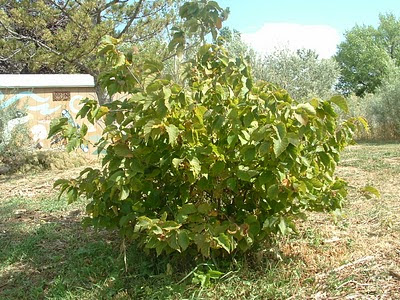 The first two pictures are of a hazelnut bush.
 Rosehips are full of vitamin C and my three-year-old loves them.
 Elderberry

 The first two pictures are of a hazelnut bush.
 Rosehips are full of vitamin C and my three-year-old loves them.
  Elderberry
Subscribe to:
Posts (Atom)